
Salisbury City Directory Holdings
Salisbury's printed directory record begins with a small, uneven run rather than one complete shelf. Local historic-resource surveys report a 1901 issue from Interstate Directory Co.; Piedmont issues for 1907-08 and 1910; a 1919-20 Salisbury-Spencer volume; 1922-23, 1924-25, and 1928-29 listings; and a 1940 Piedmont issue. The NCDOT survey also describes 1926-1950 runs as Baldwin Directory Company, followed later by Nelson's. Those reports are a route to locate a volume, not a substitute for checking its title page and the repository catalog.
| Collection | Years | Where Held | Access |
|---|---|---|---|
| Interstate Directory Co. Salisbury issue | 1901 | Reported in local historic surveys | Verify the volume through local collections |
| Piedmont Directory Co. issues | 1907-08, 1910, 1940 | Reported in local historic surveys | Check title page and repository record |
| Salisbury-Spencer directory | 1919-20 | DigitalNC, call number C971.80 S16d v.6(1919/1920) | Page-image viewer |
| Commercial Service and later reported runs | 1922-23, 1924-25, 1926-1950, 1928-29 | Historic surveys and local-history collections | Catalog, History Room, and title-page check |
The Edith M. Clark History Room is the practical local stop when a cited volume is not online. Its books, microforms, manuscripts, maps, surname files, and newspaper resources can supply the supporting evidence that turns a directory hit into a better documented Salisbury household trail.
Salisbury Directory Publishers
Publisher names need special care in Salisbury. The DigitalNC record identifies the digitized 1919-20 item as created by Ernest H. Miller and Piedmont Directory Co. A National Register survey instead calls that 1919-20 directory a Commercial Service Co. publication. The NCDOT historic survey adds its own chronology for 1924-25, Baldwin issues from 1926 through 1950, and later Nelson's volumes. Preserve the conflict in notes rather than choosing one label from a secondary summary.
- Record the directory year exactly as printed on the cover and title page.
- Copy the publisher, city, and edition statement from that title page.
- Keep the DigitalNC identifier or local call number with the citation.
- Use the survey chronology to find nearby years, then verify each physical or scanned volume separately.
That title-page discipline is especially useful for a combined Salisbury-Spencer volume. A place name, publisher, and date are all part of the source, and a later summary may simplify one of them.
Salisbury History Room Directories
The Edith M. Clark History Room at Rowan Public Library is the strongest local starting point for a Salisbury directory search that needs context. The room covers western North Carolina genealogy and old Rowan County and reports more than 19,000 books, 5,700 microforms, 268 manuscript collections, journals, oral histories, films, and maps. Its online surname index and vertical files can help identify a family spelling before a volume is pulled. The headquarters is at 201 W Fisher Street; the History Room/Genealogy Reference line is 704-216-8253.
The History Room collection page documents the Salisbury directory research setting and its local holdings.
The room is useful when a directory page needs to be tested against a surname file, manuscript collection, map, oral history, or local newspaper. Research requests are limited, so a focused request should include the name, directory year, street if known, and the exact question.
Online databases listed by the room include Ancestry, Fold3, African American Heritage, HeritageQuest, and the Historic North Carolina Digital Newspaper Collection. Treat those services as finding aids and retain the original directory citation or archival reference with every conclusion.
Salisbury DigitalNC Directory Volume
The digitized Salisbury-Spencer, NC 1919-1920 record is the clearest online directory item identified in the research. DigitalNC supplies the creator information, Rowan County subject, call number, and the Internet Archive identifier salisburyspencer06pied. Use its page images to inspect the directory title, date, street or address pages, household or business entries, and the publisher's own conventions. OCR can help find a word, but the scan should settle spelling and layout.
DigitalNC's 1919-20 directory viewer is the source for this digitized Salisbury volume.
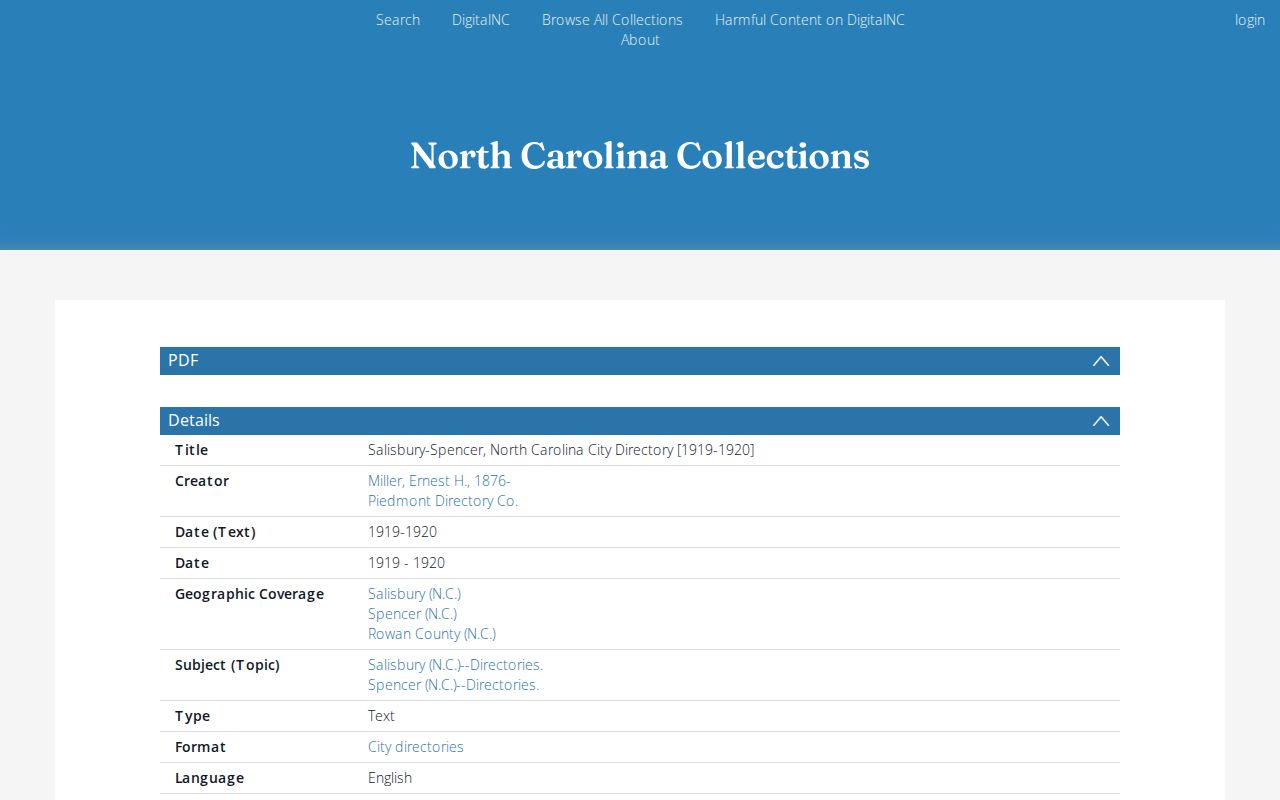
The viewer preserves the item as a dated object. A name found there belongs to the 1919-20 volume, not to a current Salisbury address, and it should be paired with an independent source before it is described as a historical residence.
Note: Digital scans can make a volume easy to search, but their text recognition does not replace a close read of the printed page.
Reading Salisbury Directory Entries
A Salisbury directory entry should be captured as an inventory, not expanded into facts the line does not state. Start with the printed name or business, then note the street or address reference, the section where it appears, the directory year, and the publisher. Household and business pages can offer different kinds of context. If a line includes an occupation, business connection, spouse notation, or an abbreviated status, quote the form used in that volume and keep the page image or page number beside it.
| Printed name or business | Copy spelling, initials, punctuation, and any suffix as shown. |
|---|---|
| Address reference | Record the house number, street form, or address-page placement without converting it to a modern address. |
| Context field | Note an occupation, business, spouse notation, or other detail only when the entry prints it. |
| Source identity | Keep volume title, year, publisher, page, and whether the entry came from a household, street, or business section. |
- Criss-cross directory
- An address-ordered section used to move from a street location to entries printed for that address. Check the individual volume because the research does not establish one in every Salisbury run.
- Householder index
- A surname-first portion that helps locate a household entry before comparing its address with another source.
- Abbreviation key
- The publisher's explanation of short forms, usually near the front matter. Photograph or cite it before interpreting a mark.
Salisbury Directory Addresses and Sanborns
A directory address can be paired with a Sanborn sheet to understand the building and block, not to identify a person. The Library of Congress Salisbury March 1896 Sanborn set has seven public-domain sheets and identifies its city, county, date, and sheet files. Local survey material also cites Salisbury Sanborn years 1885, 1890, 1896, 1902, 1907, 1913, 1922, and 1935 at the History Room, while another survey describes 1896-1931 and 1950 on NC Archives microfilm.
Those differing range statements are catalog questions to resolve, not dates to blend into a single run. A sheet can show footprint, building use, and surrounding commercial or residential context. It cannot certify who lived or worked in a building. For an old Salisbury address, retain the directory year, map date, sheet number, and the original street wording as separate fields.
Salisbury Directory Civic Memory
The Rowan Museum's 1857 Courthouse record supplies a local historical anchor for directory research. Salisbury became the county seat in 1753, began as Rowan Court House, and adopted the Salisbury name in 1755. The museum describes the 1854-57 courthouse as the third structure, notes its survival of Stoneman's Raid, and says it served until the early twentieth century. That history helps distinguish an old directory address from the broader county institutions that produced related court and land records.
The Rowan Museum courthouse page is the source for this Salisbury historical-directory context image.
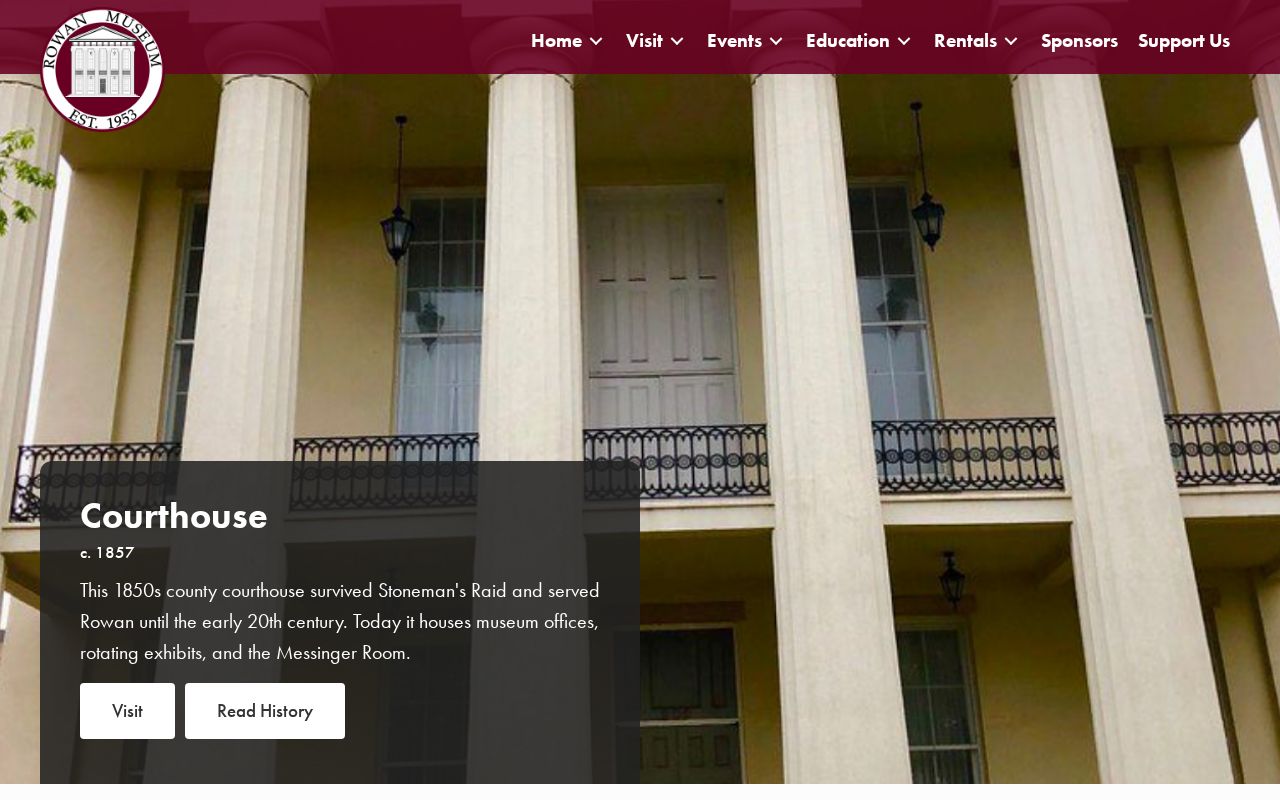
The courthouse history is context, not evidence that a named directory entry appeared in a court file. Use it to frame the record landscape, then seek the specific directory, deed, newspaper, will, or court record that supports the person or address under study.
Salisbury Directory Newspaper Trails
Newspapers and Archives material can test a dated directory lead. The NC Archives newspaper guide lists partial Salisbury and Rowan runs, including Evening World, 1895-1898; Old North State, 1866-67 and 1869-71; Republican Banner, 1854-57; Salisbury Banner, 1858-62 and 1867; Salisbury Daily Index, 1899-1900; Salisbury Daily Sun, 1897-1904; and Salisbury Examiner, 1881-85. The list is an era map, not proof that every issue is digitized or survives.
The Archives also holds county material such as marriage bonds before 1868, later licenses, estates, guardians, inheritance tax, divorces since 1835, and historical court records. Its copy-request form asks for a person, year, county, and relevant details. In-state searches have no upfront search fee; copies cost $2 for up to 20 pages and $0.10 for each additional page. The historical Salisbury District Superior Courts finding aid identifies minutes from 1755 onward, while Rowan wills are indexed across 111 fibredex boxes for 1743-1971.
Trace Salisbury Directory Households
Following a household works best as a source-by-source chain. Do not turn a missing name into a conclusion. A person may have moved, died, been omitted, used a different initial, appeared only in a business section, or been absent from a subscriber-oriented volume. The steps below preserve the gaps and connect each Salisbury directory entry to evidence made for a different purpose.
- Find the first useful Salisbury directory entry and record the exact name, year, publisher, page, and address form.
- Check nearby directory years, looking for the same household, a changed street, or a business entry.
- Pair the directory years with the appropriate census years and retain the jurisdiction and original place label.
- Use the 1896 Sanborn or another dated map only for building and block context, then compare the Rowan Register of Deeds book/page or tax-card transaction if an address connection is needed.
- Use newspaper, probate, will, court, or Archives material to test a disappearance, move, estate role, or address association.
When the research question shifts to a modern parcel, owner, or recorded instrument, the address-keyed workflow belongs with the Salisbury Street Directory. Keep the historical directory citation intact rather than replacing an old street form with a current one.
Salisbury Directory Geography Before 1836
Older Rowan records require a geography check before they are attached to Salisbury. Rowan County formed in 1753 from Anson and originally covered a much larger area; the county plan says the present boundaries stabilized by 1836. An eighteenth-century deed, will, court minute, or newspaper reference to Rowan may therefore describe a place outside modern Salisbury or even outside present Rowan County. Preserve the source's original place name, check the date, and resolve the historical county boundary before plotting an address on a current map.
This is a useful human-scale safeguard for family history. A directory can trace a later Salisbury household, while the prior generation may need to be found through an old Rowan jurisdiction, an Archives box list, or a will index instead of a modern city label.